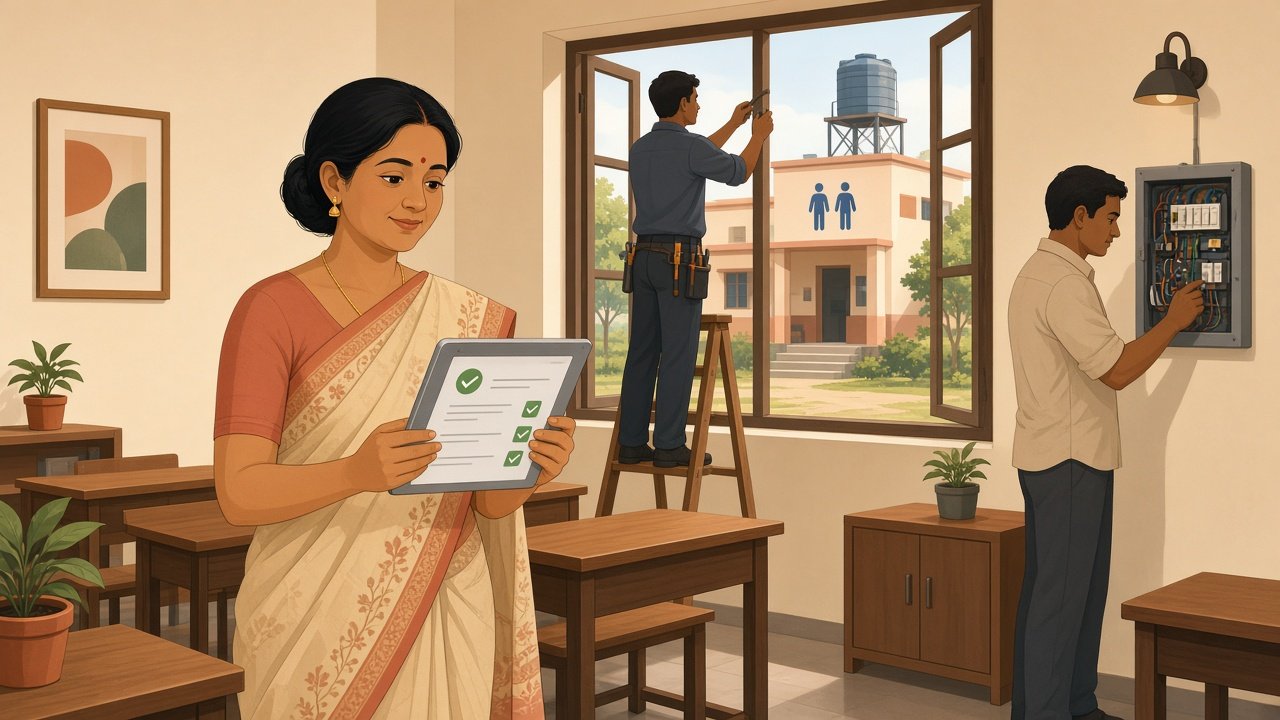
Maharashtra's School Education Department has asked every school in the state to run a special cleanliness and maintenance drive from 18 to 31 October 2026. The department's circular, dated 16 October and titled "Chala Shalet Jau Ya… Vishesh Shaley Swachhata Mohim", splits the drive into two weeks: 18–24 October to inspect and plan, and 25–31 October to clean and repair. Maharashtra schools are in inspection week right now. Elsewhere, the same two-week routine is a sensible way to check a school before a new term.
Below is a school maintenance checklist by area, a plan for both weeks, a simple way to record findings, and why it all goes faster when you already know what's in every room.
What does the Maharashtra drive ask schools to do?
According to the circular, and reports in Hindustan Times and mid-day:
- Phase 1, 18–24 October (planning and preparation): hold a special School Management Committee (SMC) meeting; plan participation by teachers, parents, alumni and the community; inspect classrooms, the office, laboratories, the library, the computer room, toilets, drinking water facilities and the playground; list the cleaning, repair and beautification work needed; sort out unusable material and scrap; identify minor repairs; and prepare a school-wise action plan.
- Phase 2, 25–31 October (the actual work): deep cleaning of rooms, including floors, walls, doors, windows, ceilings and fans; special cleaning of toilets and handwashing areas; cleaning of drinking water tanks and the water supply; clearing waste; steps against mosquitoes and insects; waste segregation; and minor repairs to electrical fittings, water supply, toilets, furniture, doors and windows. Dangerous electrical connections, broken furniture and other unsafe spots are to be fixed urgently.
- Scrap: unusable material is to be sorted and disposed of following the procedure in the department's earlier circular of 17 September 2026.
- Money: costs can be met from the composite school grant under Samagra Shiksha. No separate fund will be given, and schools must not collect any compulsory contribution from students.
- Responsibility: the headmaster is responsible at school level, with cluster, block and district education officers reviewing. Schools are also asked to keep before-and-after photographs.
If your education officer has given you more specific instructions, follow those and the circular itself.
School maintenance checklist by area
Use one sheet per room or area. Against each item, mark OK, Needs repair or Unsafe — fix now.
Electrical
- Exposed or loose wiring, open junction boxes, broken switchboards and sockets
- Extension boards and temporary connections, especially in the computer room and labs
- Ceiling fans: loose mounting, wobble, missing screws
- Lights working in classrooms, corridors and staircases
- Main switch and distribution board closed, labelled and not used as a storage shelf
Anything that could give a child a shock goes in the Unsafe column. Switch it off or isolate it the same day, and get a qualified electrician to repair it.
Furniture
- Benches and desks: broken legs, loose planks, nails or screws sticking out, sharp edges
- Chairs, teacher tables and cupboards: stable, with tall cupboards and racks that can't tip over
- Lab stools and library shelves
- Everything that should be in the room is actually there
Doors, windows and the building
- Doors open and close properly; hinges, bolts and handles work
- Window glass intact; grills firm; latches work
- Ceilings and walls: damp patches, cracks, loose plaster above where children sit
- Staircases, railings and corridors: loose railings, broken steps, slippery patches
Water tanks and drinking water
- Tanks covered with secure lids; date of the last cleaning noted
- Taps, pipes and drinking water points not leaking, and the floor around them dry
- Any water purifier or filter serviced as its manufacturer recommends
- Drinking water points that younger children can reach safely
Toilets and handwashing
- Separate, working toilets for girls and boys, with doors and latches that work
- Water supply, flushing and drainage working; no blockages or leaks
- Handwashing points with water and soap
- Lighting and ventilation
- A cleaning schedule that is displayed and followed
Playground and open areas
- Waste, scrap and old construction material cleared
- No stagnant water where mosquitoes can breed
- Boundary wall, gate and play equipment checked for damage
Fire safety and first aid (general good practice)
The circular is about cleanliness and repairs, not fire safety. But while staff are in every room anyway, check that fire extinguishers are in place, reachable and within the service date on their tag; that exits and corridors aren't blocked by stored furniture or scrap; and that the first-aid box is stocked. Your local fire authority's and board's requirements still apply; this list doesn't replace them.
How to run inspection week, then repair week
Inspection week (18–24 October in Maharashtra):
- Hold the SMC meeting early. Agree who inspects which block and the order of work.
- Divide the school into areas and give each area to a pair — one teacher and one support staff member — with the room sheets.
- Take "before" photos of each area as you inspect it.
- By the end of the week, combine every sheet into one action plan: what, where, the problem, priority, who fixes it, and how it's paid for.
- The headmaster and SMC review the plan. Unsafe items go first. Check that each expense is allowed under the composite grant before work starts.
Repair week (25–31 October in Maharashtra):
- Fix Unsafe items first, then repairs, then cleaning and beautification.
- For each completed item, note who did it, the date, and take an "after" photo from the same angle as the "before" one.
- Sort scrap and unusable items and dispose of them through the department's write-off procedure. Note what left the school.
- Finish with a walk-through by the headmaster and an SMC member; carry anything unfinished forward with a new date.
Who signs off?
- The area pair signs each room sheet.
- A staff member checks each repair before it is marked done.
- The headmaster signs the final action plan and completion list. In Maharashtra, the circular makes the headmaster responsible for the drive at school level. An SMC member countersigning is good practice.
Keep room sheets, the action plan, photos and bills in one file for when the Kendra Pramukh or block office asks.
How to record findings
A simple table is enough. Keep these columns:
| Area / room |
Item |
Problem |
Priority |
Action and owner |
Due |
Done on |
Photo ref |
| Class 6B |
Ceiling fan |
Wobbles; loose mounting |
Unsafe |
Electrician; office to arrange |
25 Oct |
|
6B-01 |
| Girls' toilet, ground floor |
Tap |
Leaking |
Needs repair |
Plumber |
27 Oct |
|
GT-02 |
| Computer room |
Extension board |
Cracked casing |
Unsafe |
Remove today; replace |
25 Oct |
|
CR-01 |
Use one row per problem, not per room, so nothing gets lost when a room has three issues.
Where an asset register helps
Inspection goes faster when the inspector carries a list of what should be in the room. Without one, they count and write from scratch. With one, they tick what's there and flag what's missing, moved or broken.
- Inspect against the list. If the register says a classroom should have a certain number of desks and you count fewer, you've found a gap before anyone asks about it.
- Record transfers when furniture moves. A drive like this always shifts things around: benches go from one room to another, broken chairs go to the store, a computer moves to the lab. If those moves aren't recorded, next term's list is already wrong.
- Know what you are writing off. Before scrap leaves campus, know which room or store it came from.
ConnectEdu's inventory module is simple asset tracking. Schools can keep more than one inventory — say, one for each block, lab or store room — listing items such as computers, desks and tables, and record transfers when items move from one inventory to another. That gives inspectors a current list to check against. It doesn't log repairs or replace your action plan, photos and bills. It sits in the same system as attendance, fees and transport (see all-in-one school software). If your school runs buses, our school transport safety checklist covers that side of safety.
Frequently asked questions
When is the Maharashtra school cleanliness drive in 2026?
From 18 to 31 October 2026. The circular sets 18–24 October for planning and inspection and 25–31 October for cleaning and repairs.
Can a school collect money from students for repairs during the drive?
No. The circular says no compulsory contribution is to be collected from students. Costs can come from the composite school grant under Samagra Shiksha; no separate fund will be given.
What should a school maintenance checklist cover?
At least electrical fittings, furniture, doors and windows, water tanks and drinking water, toilets and handwashing, and open areas. Checking fire extinguishers, exits and the first-aid box in the same walk-through is good practice.
Does ConnectEdu track repairs?
No. ConnectEdu's inventory module keeps lists of items across several inventories and records transfers between them. Repairs, photos and bills stay in your own action plan and file.
Know what's in every room before the next inspection
Set up your school's inventories once and keep them current as things move. Book a ConnectEdu school demo on connectedu.in to see inventory alongside attendance, fees and transport.
Back to Blog